Click here to read data about Muslims and Islam in the U.S. and around the world from the Pew Reserach Center. No need to restate all of the reasons why you will find this useful.
Employment services and job development for Refugees and Migrants
What are any immediate effects you’re hearing related to client jobs and employer partners after the horrible events in Paris this weekend? Please share what you’re experiencing and how you’re responding at [email protected].
Employers may have questions and concerns. Refugee’s work colleagues may be afraid or angry and react accordingly. Refugees may fear real or imagined consequences.
You could check in with key employers and working clients who might need extra support. When you know what’s going on, you can consider how to respond.
We’ll collect advice and experience from the network and share employment services strategies to consider.
Meanwhile, here is an excellent step-by-step explanation of the rigorous security process that every refugee being considered for U.S. resettlement must complete before we receive them. Thanks to USCRI for making it widely available for all.
Sometimes, it’s hard to know if a refugee family will really be better off if they add additional income to the mix. “If a low-income family earns more money, how much will the family’s benefits from safety-net programs go down, how much will state and federal income and payroll taxes change, and how much will the family’s total income go up?”
The Net Income Calculator, a user-friendly tool from The Urban Institute gives you the bottom line and makes a complex calculation relatively simple.
You first select the variable you want to test - either wages earned or hours worked. The tool generates scenarios at a few different intervals for comparison.
To test the tool, Higher plugged in numbers for a family of 5 (children ages 10, 4 and 2) living in Texas. The husband earns $8.00/hour in a full time job. The wife has the opportunity to add income from a 20 hour a week job earning minimum wage. The tool requires estimates of unsubsidized monthly rent and total child care costs.
All calculations related to benefit amounts, tax credits and taxes are built into the model. All of you definitely have enough knowledge to use the tool accurately and you don’t have to be a math whiz, either.
Several charts are generated to show you the net impact on family finances at two different levels. In our example, the levels are 20 and 40 hours a week of added income from the wife’s potential new job.
You can see two of the charts delivered for our example at left and below.
This example is consistent with my experience in Austin, TX. There is less than $100 net increase in family income in adding a parttime job for the wife. Are there other benefits, including improved English and future work opportunities? Yes.
Do those outweigh the concerns the family might have about childcare, cultural factors and additional stress? No matter the support and coaching you provide, the final decision is up to the family.
How many times have you discovered successful clients you didn’t really realize were resettled in your city? If they’re in a position to help you connect with a new employer, even better.
With the turnover in our network, many of us don’t know the history of our work. Others lived it but might have lost touch with some of those early clients.
Click here to read about the 5 biggest refugee populations we have resettled in the past 20 years. If anyone has a story or additional facts to share, let us know.
Learn how to advocate for client rights, make employer lives easier and expedite client passage of work authorization verification.
Join keynote presenters from the Department of Justice Office of Special Counsel to learn all of this and more. Even if you’re experienced in our work, you’ll learn some new detail to help clients get to work faster.
Please join us Wednesday, January 28th at 3pm EST. Register for the webinar here.
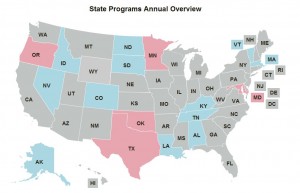 ORR’s website has a clickable US map where you can find lists of all of the ORR-funded refugee resettlement programs in each state. Click here and consider bookmarking the site for futurre reference.
It’s useful when employers want to tell their colleagues how to get great employees and supportive services.
Sometimes, clients outmigrate and you might want to give them information about where they might seek services in their new community.
If nothing else, it’s interesting to see where our work happens all over the country.
 Legal questions for our clients cross our desks every day. Most of us are not legal experts, but solutions to the resulting barriers to employment are part of our core work.
If we’re confused and unsure, imagine how our clients feel when faced with navigating the effects of a criminal conviction, understanding “the right to work”, legal status adjustments and how to obtain a range of benefits and basic services.
First Steps: An LIRS Guide for Refugees, Asylum Seekers and Migrants Released from Detention is a FREE comprehensive guide to legal issues written in plain language accessible to non-native English speakers and people of all kinds without a legal background.
Visit lirs.org/firststeps to download and learn more about First Steps. It will be a great resource for you and for your clients.
Read what a resettlement case manager and a former refugee lawyer say about how this new resource can help.
Navigating the legal and social services systems as an immigrant are hugely challenging tasks, which are all too often compounded by the misinformation circulating outside our office doors. [First Steps] is going to be a great asset for the populations we serve and I cannot wait to start getting this out there! Casie-Lee Miller, a case manager at LIRS partner Ascentria Care Alliance
First Steps tells new Americans “yes, you will make it, my friend.” It’s a guide that will start to take away from that uncertainty, from that fear, from that inability to trust again. Guiding refugees to the ways of this country and its culture will help them be more familiar with it, and therefore have a feeling of being accepted sooner. Selena Sujoldzic, lawyer and former refugee
More than 18,000 Iraqi and Afghan SIVs and their families have come to the U.S. between FY 2007-2013.
Click here to access the recently released report from the Congressional Research Service for a thorough explanation of the nuances of the program.
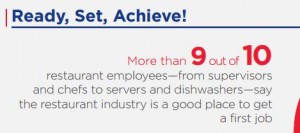 Did you know that 52% of dishwashers surveyed would like to work additional hours? Given the frequently parttime nature of this common starter job for our clients, this statistic isn’t surprising.
A useful infographic from the National Restaurant Association offers several facts that are surprising about upward mobility, employee longevity and a strong pathway to small business ownership. Click here for a PDF version.
The visual presentation and strong factual evidence could help resistant clients better appreciate where entry level restaurant jobs can lead.
Thanks to HR Bartender, where I found the resource. You can read much of the source research for the infographic here.
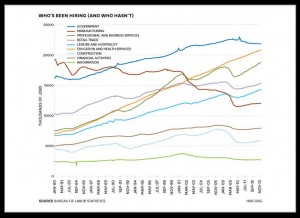 The Harvard Business Review analyses long term hiring trends with five charts (click here) and analysis.
The bottom line is that economic recovery has not delivered enough jobs to match 2008 levels but certain sectors and industries have experienced steady growth.
Government is the top sector, followed by education and health services. Growth in home health care jobs didn’t surprise me. Lack of growth in information industry jobs did.