As part of its Self-Sufficiency Series: Solutions from the Field, The U.S. Department of Health and Human Services (HHS) recently published a blog post highlighting the women’s sewing class offered by World Relief – Seattle. To see the post and to learn more about the series, click here.
Labor Market Information Strategies: Wage and Benefit Negotiation
Labor Market Information (LMI) is an excellent source of national and state job market data that resettlement programs utilize to make informed decisions on employers, particular industries, and wages. LMI might seem complicated and overwhelming to jump into; however, the benefits to you and your clients are well worth the effort. Here is an example from Atlanta.
Lutheran Services of Georgia
Lutheran Services of Georgia Matching Grant program has been using LMI to empower their job developers with knowledge and tools for self-sufficiency success. Job Developer Meron Daniel shows us how. Meron noticed that while most families in LMI’s Matching Grant Program are self-sufficient and are financially comfortable enough to pay their bills, many are unable to save enough money to make major purchases such as a house or car, and may not have a financial cushion in case of an emergency. Thus, Meron explored ways to increase client wages.
Meron started by gathering information on pay and benefits from employers that were already hiring refugees. Then, she used LMI to compare that data to wages for the same industries in the Atlanta area. Armed with this information, Meron was able to demonstrate to a potential hotel employer offering a starting wage of just $8.50 an hour, that other hotels were paying $9.50 to $10 per hour for the same position. As a result, the hotel came onboard at $11 an hour – clients are happy and the hotel is competitive with its peers and has improved employee retention. A win-win outcome for everyone.
Suggestions
When negotiating on behalf of clients, Meron advises having your pitch and LMI data ready, being transparent with the employer, highlighting all the costs a particular family may have, emphasizing the services your agency provides, and stressing how vital it is for the family to be self-sufficient. In Meron’s experience, Human Resource recruiters have been open to negotiations and may even use the LMI data to make the case for higher wages to their corporate bosses. Meron recommends that if an employer cannot immediately increase pay based on the LMI information, perhaps they will be willing to offer other employee benefits such as free transportation or expanded health care benefits.
Finding LMI for your area
Higher’s Guide to Labor Market Information tells you how to access specific LMI and offers specific examples on how to use the data in negotiations. LMI databases, like CareerOneStop or O’NET, have tools available to find wage information for industries in particular areas. Additionally, each state has an LMI expert that is available to help create reports or answer questions.
How do you use labor market information when meeting with employers? Share with us at [email protected].
Interactive Map Shows Foreign-trained Occupational Licensing Law Updates
IMPRINT has created a map showing legislative updates related to the occupational licensing of foreign-trained immigrants and refugees. IMPRINT is a coalition of organizations such as the Welcome Back Initiative, the Massachusetts Immigrant and Refugee Advocacy Coalition, and Upwardly Global that identifies and promotes best practices in the integration of immigrant professionals.
Click here to see if your state has laws that are either pending or have been enacted from 2014-2017. Several of the laws focus on healthcare professionals; educational and architectural professionals are also included. Other laws establish task forces that will evaluate credentials and workforce integration of foreign-trained professionals, rather than focusing on specific industries.
While you’re visiting IMPRINT’s website, check out another resource they have available, mentioned in a previous Higher blog – a map showing organizations and resources available for skilled immigrants across the country.
Guest post written by Carrie Thiele
Workforce Collaborative Brings Together Local Service Providers to Enhance Refugee Work Readiness
When looking at ways to enhance your job readiness training or employment placement, has your agency tried looking into existing community organizations doing similar work?
Local collaboration can mean more than working with other refugee agencies. Collaboration and partnership with other nonprofits in your community doing similar work can maximize the benefits of your employment programs. Like using a bank to teach your financial literacy courses. Looking to other nonprofits who are doing job development or job readiness courses is a great way to further develop opportunities for your clients.
This week, guest blogger Elizabeth Ringler shares an example from Pennsylvania.
A workforce collaborative in Pittsburgh, Pa has launched a new initiative to enhance refugee work readiness through targeted training. The collaborative includes the Career Development Center at Jewish Family and Children’s Services, which is a resettlement agency, and the Greater Pittsburgh Literacy Council. Together, the two organizations serve large numbers of refugees and immigrants in Allegheny County, Pa. This collaboration was made possible through the All for All Immigrant Workforce Initiative organized by the City of Pittsburgh.
Refugees participating in the program meet twice a week to learn job readiness skills including how to look for a job, resume writing, interview preparation, and networking skills. The program also offers opportunities to enhance participants’ computer literacy and workforce specific English language skills. Additionally, the program offers on-site childcare for participants.
“This program aims to teach immigrants about the American job search process and work culture, and supports each individual in developing a job search strategy that meets their needs and leads to long term career success. By working with regional employers, we hope to showcase the important role and economic value immigrants have in Pittsburgh,” says Career Development Center Director Sarah Welch.
To learn more about the All for All Immigrant Workforce Initiative, contact Iris Valanti, Public Relations Associate, Jewish Family & Children’s Service Email: [email protected]
If your agency does a similar event please write to us at [email protected] to share your story.
How to Gain the Attention of Learners - Video & Infographic
One of today’s sessions in Denver is titled “Job Readiness Activities for Adult Learners“. The session is designed around the LIRS eLearning module, Adult Learning Principles, and focuses on seven steps to ensure learning, beginning with gaining the attention of learners.
The session will begin with “The Balloon Game”, a fun activity that is easy to connect to the competitive nature of the U.S. job market. The short video below (an excerpt from Adult Learning Principles) explains how to conduct the activity.
Next week, we’ll share a list of tools, activities and resources that are effective in job readiness classrooms across the country. In the meantime, the below infographic has tips for gaining the attention of your audience so they are motivated and ready to learn, whatever comes next.
Please contact us for access to Adult Learning Principles in Higher’s Online Learning Institute.

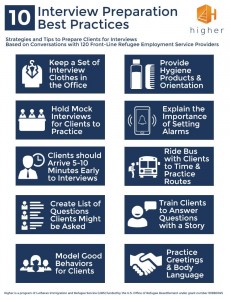
Your Top 10 Interview Prep Best Practices
10 Interview Preparation Best Practices is a visual collection of your tips, tricks, and best practices for providing clients with the skills they need to successfully interview for employment.
This is the second of five resource sheets from speed dating”, where 120 refugee employment service providers at our Second Annual Refugee Employment split into small groups and spent 10 minutes discussing each of five topics.
Be sure to download the complete set of notes here. There’s so much great information it was hard to know where to start!
Looking for more interview preparation resources? Through Higher’s Online Learning Institute, we offer several free eLearning modules that you and your clients can access. Consider showing one in job readiness class or one-on-one with clients. Interview Behavior Videos or How to Answer Behavioral Interview Questions are great resources to check out.
We have several other resources in the works, so be sure to check back often. As always, please let us know your ideas for other resources to make your jobs easier.
7 Tips if You’re New To Job Development
If you’re new to refugee job development, welcome to what is sure to be one of the most challenging and rewarding chapters of your career! Maybe you’re fresh out of college or perhaps you’re a career changer looking for more meaningful work.
You are likely very excited about your new position but you’ve probably also had a few moments of wondering what you’ve gotten yourself into. You have a long and growing list of clients that you need to place and many of them have significant barriers to employment. You’re beginning to think that your title should be Miracle Worker instead of Job Developer. Well guess what? We’ve all been there!
Here are 7 tips to get you through your first few crazy months as a Job Developer:
1. Breathe! What you are experiencing is normal. The work that we do is not easy, but it is rewarding! Murphy’s Law (“whatever can go wrong, will go wrong”) will summarize many of your days as a Job Developer, but there will also be many days where you will celebrate amazing successes with clients and coworkers.
2. Realize that there is a seasonal nature to the work that we do. Ask your coworkers or a supervisor to help you know what to expect at different times in the year. There are times in the year that will be slow and times that will be insane, both in terms of employer hiring and refugee arrivals. October and November will be crazier because of the recent bulge in refugee arrivals and also because employers do a lot of hiring in the fall. December and January are typically slow months in terms of employer hiring.
3. Get a mentor. Mentors are good for your clients, and they are good for you. Find a coworker who is more experienced and ask if they can share what has worked for them, and how they’ve dealt with the challenges of the job. Find an opportunity to “shadow” them as they do employer outreach. After watching them make their pitch to a few employers, try taking the lead on the next few employer visits, and ask your mentor for feedback.
4. Get out of the office! After going out to do employer outreach with your mentor once or twice, get out there and do it yourself. It will be scary. You’ll stumble over your words. You’ll get strange stares and doors slammed in your face. But you’ll get better. Success will come through practice and through getting out there and building relationships with employers. These relationships will not happen by looking at craigslist or doing online job applications; they will happen by you getting out there and “pounding the pavement.”
5. Focus on the Needs of Employers. While there is a humanitarian aspect to the work that we do, focusing on the difficult circumstances of our clients when we speak to employers is not likely to lead to long term partnerships. Employers become partners when they see that you understand the needs and challenges of their business, and can offer them consistent and effective solutions (i.e. motivated, reliable and dependable employees). Overtime they may become passionate about helping refugees, but your job is to help them take the first step by convincing them that hiring a refugee is good for their business.
6. Have balanced expectations of your clients. Never underestimate your clients. Don’t be too pessimistic. Refugees are survivors and some of the most resilient people on the planet. You will feel like it’s impossible for some of your clients to get and keep jobs. Many of your clients will prove you wrong. On the other hand, be careful about being overly-optimistic about your clients with higher levels of English and literacy. Starting over in a new culture is a huge challenge for all refugees. Higher skilled clients have their own share of challenges, whether those be unrealistic expectations, trauma, or cultural adjustment issues. Regardless of skill level, the key is to identify barriers to employment early and work with your clients to develop an employment strategy that helps them overcome these challenges.
7. Sign up for Higher’s Online Learning Institute. Our eLearning modules will get you up to speed on best practices in the field ranging from conducting employability assessments, to communicating with employers, to writing effective case notes. Learn more about Higher’s Online Learning Institute here.