Simple Strategies to Address Common Barriers, Part 4

At a recent Maryland-wide workshop which focused on refugee workforce development, Higher had participants do a brainstorming activity, in which groups worked together to list common barriers refugees face to employment as well as possible solutions.

These types of activities inevitably generate a “wish list” of solutions which are great ideas but not always in our power to implement quickly (e.g. adding staff members, ESL at work sites, home-based self-employment for refugee women).

While there are certainly times to pursue those big ideas, perhaps the best thing about exercises like this is that they allow groups to identify simpler solutions that can be implemented immediately.

Over the next few weeks, we’ll share some of these insights from your Maryland peers, focusing on simple and practical strategies that are relatively easy to implement! So far, we’ve focused on tips for overcoming Limited English Proficiency (LEP) challenges, tips for overcoming transportation challenges and tips for overcoming childcare challenges. This week we’ll share a few tips on overcoming the barrier of Computer Access/Digital Literacy.

Tips for Overcoming Computer Access/Digital Literacy Challenges:

  1. Connect clients to local computer labs and/or digital literacy training opportunities. Suggested Resource: The Literacy Directory lists free resources to help adult students reach life goals in areas such as improving reading, math, and science skills, learning English, building job and job search skills, becoming a U.S. citizen, and finding adult education, child, family, and digital literacy programs.
  2. Help clients access low-cost computers. Suggested Resource: EveryoneON is a national nonprofit working to eliminate the digital divide by making high-speed, low-cost Internet service and computers, and free digital literacy courses accessible to all unconnected Americans. A true digital literacy initiative, they aim to leverage the democratizing power of the Internet to provide opportunity to all Americans – regardless of age, race, geography, income, or education level. Let’s help them do this!
  3. Educate clients about affordable internet options. Suggested Resource: ConnectHome is a public-private collaboration to narrow the digital divide for families with school-age children who live in HUD-assisted housing. ConnectHome is the next step in President Obama’s continued efforts to bring affordable broadband access, technical training, digital literacy programs, and electronic devices to all Americans.
  4. Utilize interns and/or volunteers to help clients improve their computer skills. Suggested Resource: DigitalLearn.org is a collection of self-directed tutorials for end-users to increase their digital literacy, and a community of practice for digital literacy trainers to share resources, tools and best practices.
  5. Encourage your clients to work with you on this challenge, asking them to network within their community to explore solutions.

Stay tuned for more tips from MD refugee employment programs and stakeholders. The final part in this series will address unrealistic client expectations.

Do you recommend any additional digital literacy resources? Feel free to participate in the conversation by leaving a comment below or sending us an email at [email protected].

Libraries: Important Community Partners

Louisville Public Library

Connecting our clients to community resources is an important step toward long term success. Libraries offer free access to all kinds of resources including ESL classes, summer youth programs, internships, job boards, computer and internet access.

Nearly two-thirds of libraries provide the only free computer and Internet access in their communities, the Associated Press reported last year.

Read about how one library is addressing mental health and other social service needs of the homeless community in San Francisco.

Many refugee resettlement programs already partner w libraries, offer tours and use volunteers to help new arrivals obtain library cards. Share how you are partnering with libraries in your community by commenting on this post or by email at [email protected].

Proof that First Jobs Lead to Career Success

my first jobWhat if your clients could hear Omar Epps, Jimmy Fallon and other famous and very successful people talk about the marketable skills their first jobs taught them?

Accepting the first available job is the foundation of client success (and ours, too). “Starter” or transitional jobs are very seldom dream jobs. Helping clients adjust their expectations can be challenging. Linking their first job to a longer term career path is an important strategy that can help. It’s not an easy sell, though.

Check out a series of First Job Videos provided by the White House as part of their youth jobs initiative. Videos featuring Fred Wong (Waiter), Cris Comerford (Salad bar girl), Jimmy Fallon (gum scraper) and Omar Epps (pizza delivery guy) are especially relevant.

My favorite is from Ceclia Munoz (below) who talks about the marketable skills she learned in her first job at McDonalds in 27 seconds.


6 Fundamentals to Help Highly Skilled Clients You Might Not Know About

Med Pro Group iStock_000022514360XSmallAlthough archives from a recent LINCS’ Working with Immigrant Professionals webinar are not yet available, Kelly Rice, Employment Program Manager at the International Center of Kentucky in Bowling Green heard some valuable new ideas and quickly did two things to follow-up.

She started a Skilled Immigrant and Refugee Resources Working Group on Linkedin that you are welcomed to join. She also conbuted this blog post with her take on working with highly skilled refugees.

A job developer’s job is never finished. We are always seeking the best opportunities for our clients, but sometimes they need to get a job quick – what do we do?

Usually, they are placed into an entry-level position until they can find that job upgrade. Many highly skilled or professionally licensed clients are placed in first jobs jobs for which they are over qualified. How do we make it easier for them to find a career path in the same field they pursued before being resettled in the U.S.?

Here are six fundamentals and the strategies I know work from research, webinars and my own experience:

  1. Integrate English language learning with other job readiness preparation
    • “Do they speak English” is the question I am asked most often by employers.
    • Advanced English classes with contextualized content (possibly online?).
    • Integrate English learning with test-taking strategies to assist participants’ career pursuits.
  2. Never underestimate the importance of social capital and social networking
    • Employers use social media, A LOT.
    • Mentorship program with career professionals.
    • Workshops and peer support groups.
    • Professional associations, Linkedin.com, meetup.com, Facebook, Twitter.
  3. Offer career coaching and mock interview preparation
    • Added benefits in professional understanding and increased confidence levels.
    • Mock interviews and feedback sessions (utilizing employer volunteers?).
    • Individual career coaching – use employment mentors who are career professionals.
  4. Utilize soft skills and language inventory
    • GED Programs, Small Business Entrepreneurship Programs or Economic Empowerment Programs are valuable resources.
    • Computer classes are usually available at libraries and career centers.
    • Public Libraries, Community Colleges, Private Language Institutes are key resources.
    • Networking!!!!!!!!!!!!!!!!!!
    • Resume vs CV, Cover Letter, References.
    • Professional Portfolio (showcase their work, projects, articles).
  5. Educate stakeholders about the value of immigrant credentials and the importance of credential evaluation
    • Enables educated immigrants and refugees to gain recognition of their credentials and access to opportunities.
    • Helps licensing boards, employers, academic institutions understand qualifications earned outside the U.S.
    • Larger employers and licensing boards usually have formal processes and/or have a preferred credential evaluation service. Know which one is required before spending any money.
    • Many employers are unfamiliar with credential evaluation or skeptical of foreign qualifications – help employers understand the process.
    • Refugees need to proactively “market” their evaluation and highlight their US equivalencies to overcome employer concerns.
  6. Help clients consider alternatives to re-licensure
    • Non-licensed teachers can work in as teachers in private schools, instructors at community colleges, adult education instructors, corporate trainers, etc. Teachers also have opportunities for alternate routes to certification, including fellowships that allow them to license while working.
    • Accountants without a CPA can work in many settings, e.g. bookkeeping, analyzing budgets and costs, etc.
    • Healthcare professionals can consider non-regulated occupations such as medical interpretation or positions in administration, research or community health.
    • Non-licensed engineers or architects can work in technical, advisory and management positions that can have an important impact on engineering projects.
    • Local Technical Colleges can team up to create Certification Programs as an alternative as well.

For example, our local Techical College started a free Certified Production Technician Program. After completing a 12 week course, graduates are guaranteed an interview at an employer in their desired field, which can lead to a significant job upgrade. This is a brand new program. Hopefully by April, we will have good news with some folks who found a great job!

Kelly RiceKelly Rice has a B.S in Finance from Virginia Tech and an HR certificate from Western Kentucky University. She worked at Wells Fargo for 8 years and joined the International Center of Kentucky in Bowling Green as Employment Program Manager in May 2013

Two Refugee Employment Success Stories: John Ajak and the Department of Interior

John Ajak, a petroleum engineer with the U.S. Department of Interior, tells his story illustrating the power of safety, education and motivation that employers harness when they hire refugees.
The Department of Interior exemplifies why employers are the strongest advocates for replicating their hiring strategy.
Wow. A snowpocalypse cabin fever discovery.

Tips for Working in the U.S. - Video

Check out advice for refugees from 28 of your peers who attended Higher’s Second Annual Refugee Employment Workshop in Omaha last week.

Let us know what you think and if there’s anything we can do to make it more useful for you and your clients. Please feel free to share with your clients, colleagues and personal networks!

Back to the Basics: Advice for Job Applicants & Job Developers

“The minute you get away from fundamentals – whether its proper technique, work ethic or mental preparation – the bottom can fall out of your game, your schoolwork, your job, whatever you’re doing.” -Michael Jordan

Without knocking innovation, sometimes the best way forward is to go back to the basics. A recent Lifehacker article made this point when they asked a couple dozen hiring managers to weigh in on how applicants can stand out from the crowd.

Here are their top 10 suggestions and how they apply specifically to refugee employment:

1. Be Prompt, but don’t arrive too early to your interview.

Many cultures have more flexible standards when it comes to punctuality than we do in the US. It’s a good idea to encourage clients to be early to appointments and interviews. But make sure to also discuss the importance of not being too early, as that can also make a negative impression.

2. Don’t apply for a job unless you meet the qualifications.

This can be a tricky one when working with refugees, many of whom may have limited English and all of whom lack US work experience when they first arrive. On the surface, it may seem like your clients do not meet the qualifications for many jobs. Don’t give up too easily though. Politely push employers to tell you exactly what competencies are necessary for the job at hand. If you think your clients are capable of performing the duties described, make the argument, and close the deal!

3. Research the company.

The more you know about the company, the more you will be prepared to make the argument that your clients are a good fit for their needs. Whenever possible, share information about the company with your clients before taking them to an interview. They will perform better if they know who they’re talking to.

4. Make the right match.

Don’t try to force opportunities that are clearly not a good fit. That will not result in long term partnerships. Making a good connection with an employer is the first step, but showing them that you understand their needs is what will keep them coming back.

5. Come prepared with questions.

Make sure you are prepared with good questions for employers and coach your clients on good questions to ask before the interview. Part of this coaching also means helping them know what questions not to ask (e.g. Can you give me a different schedule so I can work with my brother?).

6. List all your (software) skills on your resume.

This tip may apply to some higher skilled clients that have software skills but may not mention them. The basic point though is just to make sure you are using the resume to list any skills that demonstrate that you are motivated, reliable and dependable. So even if your clients don’t have formal work experience, find a way to highlight their skills.

7. If you lie, you’ll probably get caught.

Pretty straightforward. Don’t lie. Don’t even exaggerate. Do, however, find a way to present your clients in the best light possible, demonstrating their skills, and highlighting the unique ways that they will add value to employers.

8. Say thank you.

Sometimes you should be the one to say it. Sometime your client should be the one to say it. It might be a handwritten note. It might be an email. It might even be a text message to your employer connection saying “Thanks for your time today. I really appreciate your partnership.” There are many ways to say thank you. The point is that you should.

9. Don’t be pushy.

Following up is part of the process. Either you or your clients should follow up after interviews. Just keep in mind that being persistent and being pushy are two different things. If your client is going to be the one to follow up, make sure to coach him/her on how to do this professionally.

10. Put yourself in the Hiring Manager’s shoes.

Perhaps the most important tip on this list. You should always be asking yourself questions like “What does the employer want?”, “What would make their life easier?”, “What do my clients bring to the table that would really add value to this company?” If you do this consistently, employers will love working with you, and your clients will get jobs.

If you’d like to read the Lifehacker article in its entirety, you may do so here.

Multilingual Resources to Help Avoid Scams

When clients bring in mail from Publishers Clearinghouse so you can help them claim their $2,000,000, the answer is obvious. If it seems to good to be true, it probably is. Other scams - like jobs you have to pay for or calls from the IRS - can be harder to address until it’s too late.

Now, with help from IRC Silver Spring, the Federal Trade Commission has developed resources to help newly arrived refugees spot, avoid and report scams. Handbooks and posters are available in English, Amharic, Arabic, Dari, French, Somali and Spanish. Click here to download all of these free resources.

Here’s what happened according to Kate Christman, Cultural Orientation Coordinator with IRC Silver Spring.

Clear, simple language in one free downloadable poster.

The FTC was working on a project to help communities that are especially vulnerable and may not be knowledgeable about their rights or tips for avoiding scams. They reached out to the IRC for assistance. Our goal was to distill and simplify their wealth of information and materials into something more accessible for refugees and immigrants. They toured our office and attended a cultural orientation to get a better background on refugee populations. We had lengthy discussions help them get a sense of what refugees struggled with in the US. They talked with caseworkers about what scams they thought refugees were most susceptible. Then they drafted the pamphlet and we worked through a few details before they had it translated.

IRC Silver Spring includes the information in their cultural orientation, has translated versions of the posters around their offices and makes the handbooks available for clients, too.

Arabic Language Job Readiness Resources

Here is a list of helpful Job Readiness Resources in Arabic that we have collected from our network:

Many thanks to Ali Abid and Brittani Mcleod at Catholic Community Services of Utah and Carol Tucker at Lutheran Family Services, Nebraska. If you have other Arabic language resources that you would like to share please email us at [email protected].

Upwardly Global Services for Highly Skilled Refugees

Announcing a July 28 (1PM EST) webinar introduction for refugees and refugee employment programs

Everyone should already be aware of Upwardly Global programs and resources. UpGlo exists to help highly skilled professional refugees and other immigrants achieve career success and contribute their motivation, training and expertise to U.S. economic growth.

Here are three ways to make sure you are making full use of UpGlo resources to better serve refugee professionals.

1. Register to attend an UpGlo webinar. Include your clients, too!
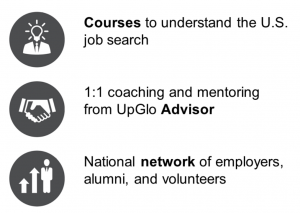
Upglo 3 step program

Three simple steps you’ll learn more about in the July 28 webinar

Attend a one hour UpGlo webinar on July 28, offered especially for the refugee employment network. You’ll learn about eligibility criteria and program services available nationally. There will be plenty of time for questions, too.

Your highly skilled refugee clients would benefit from attending themselves. The information is substantive and accessible for high-intermediate levels of English language proficiency.

2. Help medical professionals explore career options in their fields.

Learn more about another excellent FREE web-based resource presenting alternative career pathways for doctors, nurses, pharmacists and dentists in a previous Higher blog post.

3. Hear how UpGlo programs have made a difference for immigrants and mentors

Watch the Youtube video in this post, which shares the impact of UpGlo’s model in the voices of immigrant professionals and volunteer career mentors who have participated and benefitted.

If you’re trying to establish an employer partnership or employment mentor program with a hospital or care facility, sharing this video would strengthen your pitch!